Sound-based wellness covers a wide range of claims, from specific “healing frequencies” said to carry particular properties, to a genuinely studied phenomenon called brainwave entrainment, where rhythmic sound is used to nudge the brain’s own electrical activity toward a particular state. These two things get lumped together often, but they don’t rest on the same footing at all. This page separates the two, covers what brainwave entrainment actually is and how it’s thought to work, and looks honestly at what the current research does and doesn’t support.
What is sound frequency and brainwave entrainment therapy?
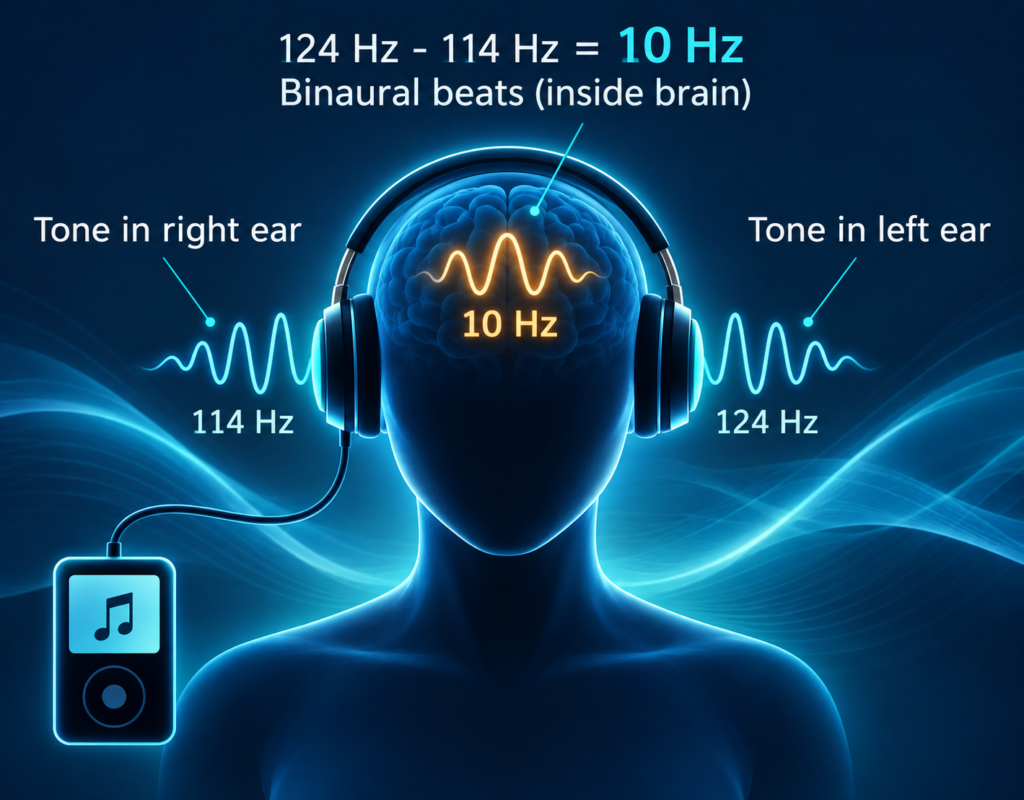
Brainwave entrainment refers to using rhythmic sensory input, most often sound, to influence the brain’s electrical activity toward matching that rhythm. The most common form is the binaural beat: two slightly different tones, one played in each ear through headphones, which the brain perceives as a single pulsing beat at the frequency of the difference between the two tones. Play 200 Hz in one ear and 206 Hz in the other, and the brain perceives a 6 Hz beat, even though no actual 6 Hz tone exists in the audio itself. Related techniques include isochronic tones, a single tone pulsed on and off at a set rate, and monaural beats, where the beating occurs in the audio signal itself rather than being constructed by the brain, so headphones aren’t required.
The idea behind all of these is that exposing the brain to a rhythmic pulse at a particular frequency can encourage brainwave activity, measurable on an EEG, to shift toward matching that same frequency, a genuine, testable phenomenon called the frequency-following response.
A brief history
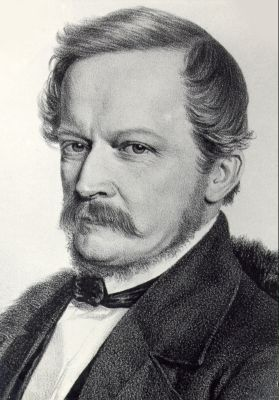
The underlying acoustic phenomenon was first documented in 1839 by German physicist and physiologist Heinrich Wilhelm Dove, who described binaural beats as a purely auditory effect. It remained largely a curiosity of physics and psychoacoustics for well over a century.
Interest in a therapeutic application picked up substantially after biophysicist Gerald Oster published an influential 1973 article in Scientific American exploring binaural beats and their potential relationship to brain activity, which brought the phenomenon to a much wider audience, including researchers interested in its neurological effects. From there, brainwave entrainment moved gradually from a niche research interest into commercial wellness and self-improvement products. First as cassette tapes and CDs marketed for relaxation and focus and more recently as dedicated apps and streaming tracks. Separately, various sound-healing traditions built around specific “sacred” or “healing” frequencies, most notably the Solfeggio frequencies, including the widely marketed 528 Hz “love frequency,” developed and spread largely through wellness and spiritual communities, with a history rooted more in numerology and reinterpreted musical scale theory than in scientific research.
How does it work?
The frequency-following response. When the brain is exposed to a rhythmic auditory stimulus, its electrical activity has been shown, in EEG studies, to partially synchronize with that rhythm. This is the real, measurable mechanism behind brainwave entrainment, and it’s genuinely different from simply listening to music you find relaxing.
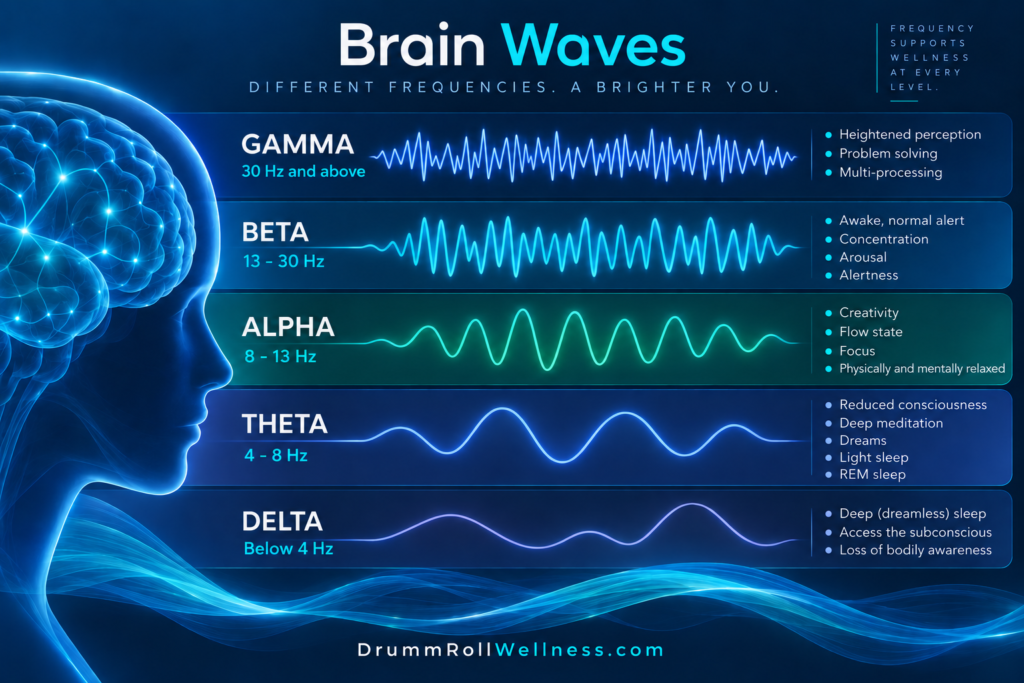
Brainwave bands and associated states. Human brainwave activity is broadly categorized into bands by frequency, and each is loosely associated with a particular mental state: delta (roughly 0.5 to 4 Hz) with deep sleep, theta (4 to 8 Hz) with light sleep, deep relaxation, and meditative states, alpha (8 to 13 Hz) with a relaxed, wakeful state, beta (13 to 30 Hz) with active, alert thinking, and gamma (above 30 Hz, often studied around 40 Hz) with higher-order cognitive processing and, more recently, specific interest in neurological health. Brainwave entrainment products are typically built around a target beat frequency chosen to sit within one of these bands, depending on the intended effect, relaxation tracks in the theta or alpha range, focus tracks in the beta range, and so on.
An important distinction: entrainment versus specific “healing” frequencies. Brainwave entrainment through binaural beats rests on a real, measurable physiological mechanism, the frequency-following response, and is an active area of legitimate scientific research, covered below. Claims about specific standalone tones, such as the Solfeggio frequencies or the particular claim that 528 Hz carries unique healing or DNA-repairing properties, are a different matter entirely. We looked for rigorous, controlled research supporting those specific-frequency claims and didn’t find a credible scientific basis for them. Their origin is generally traced to a reinterpretation of numerology and historical musical scale theory rather than to any tested biological mechanism. We think that distinction matters and would rather be direct about it than blur two very different categories of claim together under one heading.
What the research says
Anxiety, sleep, and cognition in young adults. A 2025 systematic review pulled together 10 interventional clinical trials of music and binaural beat interventions, covering roughly 970 participants across studies published between 2015 and 2025 (Read more here: systematic review, Acta Neuropsychiatrica, 2025). The review found small-to-moderate improvements in anxiety and mood, consistent positive effects on sleep quality and more variable results for cognition, with beta-frequency binaural beats showing a modest benefit on one cognitive measure. The authors were candid about evidence limitations, though: substantial heterogeneity across study designs, small sample sizes, predominantly student samples that limit how broadly the findings generalize and an overall certainty rating of low to moderate. We think that’s an honest, useful summary rather than an overstated one, and it’s the kind of caveat worth keeping in mind rather than treating the underlying effect as settled.
Anxiety in a clinical, real-world setting. A randomized controlled trial gave 50 patients with moderate-to-high preoperative anxiety either binaural beats, using tones that produced a 6 Hz theta-range beat, or no auditory intervention, before and during periodontal flap surgery (Read more here: binaural beats RCT, periodontal surgery). The binaural beats group showed a significant reduction in anxiety scores and in blood pressure and heart rate after the procedure, while the control group’s anxiety and physiological stress markers increased. It’s a small trial and specific to one clinical context, but it’s a useful real-world data point beyond the more common relaxation-app research.
Gamma entrainment and neurological health. A separate and more exploratory area of research involves 40 Hz gamma-frequency sensory stimulation, delivered through combined light and sound rather than sound alone, studied in people with Alzheimer’s disease. A long-term open-label extension study followed five participants from an original MIT trial for roughly two years of daily 40 Hz light-and-sound sessions at home (Read more here: gamma sensory stimulation extension study, MIT). Results were genuinely mixed and split along disease type: participants with late-onset Alzheimer’s maintained cognitive measures above comparable population averages and showed meaningful reductions in a tau biomarker linked to the disease, while participants with early-onset Alzheimer’s showed no significant benefit and reduced responsiveness to the stimulation over time. With only five participants, this is very early, exploratory research rather than something we’d present as established. It combines light with sound rather than being a pure sound-frequency intervention, but we think it’s a genuinely interesting example of legitimate, ongoing science in the gamma-entrainment space, distinct from the unsupported specific-frequency claims described above.
Taken together, the research picture here is a real, if still developing, one for brainwave entrainment specifically: measurable anxiety and sleep benefits with low-to-moderate certainty evidence, an interesting and promising but very early signal in neurological health and a genuine underlying mechanism worth taking seriously.
Who should be cautious, and why
Sound-based brainwave entrainment is low-risk for most people, but there are specific situations worth being aware of.
Seizure disorders. Rhythmic sensory stimulation, whether auditory or visual, carries a small but real risk of triggering a seizure in people with epilepsy or other seizure disorders. Anyone with a seizure disorder should talk to their doctor before trying binaural beats or any rhythmic sound or light-based product. This caution applies with particular weight to the combined light-and-sound gamma stimulation described above.
Migraine. Some people with migraine find rhythmic or repetitive auditory stimulation can be a trigger. Starting with a short session and paying attention to how you respond is a sensible approach if you’re prone to migraines.
Certain mental health conditions. People with a history of psychosis or certain other mental health conditions should check with their doctor before using altered-state-inducing audio, since altering brainwave activity and consciousness states isn’t necessarily neutral for everyone.
Driving or operating machinery. Because binaural beats are designed to shift the brain toward relaxed or drowsy states in the theta and delta range, they shouldn’t be used while driving, operating machinery or doing anything else that requires full alertness.
Pregnancy and children. As with several other modalities on this site, brainwave entrainment audio hasn’t been specifically studied for safety in pregnancy or in children, so a cautious, doctor-guided approach is reasonable if either applies to you.
As always, check with your doctor if any of the above applies to you and start with a short session to see how your body responds.
Frequently asked questions
Do I need headphones for binaural beats to work? Yes, for true binaural beats. Because the “beat” is constructed by the brain from two slightly different tones played separately to each ear, stereo headphones are necessary. Isochronic tones and monaural beats, which pulse the same signal to both ears, don’t require headphones.
Is 528 Hz or another Solfeggio frequency scientifically proven to heal anything? No. We looked for credible, controlled research supporting specific healing claims about individual frequencies like 528 Hz and didn’t find one. This is different from binaural-beat brainwave entrainment, which has a real, tested mechanism and a genuine, if still developing, research base, covered above.
How long does a session need to be? Research sessions in the studies above ranged from around 10 minutes to longer ongoing daily use, depending on the goal. Shorter sessions in the 10 to 20 minute range are a reasonable starting point for anxiety or relaxation use.
Can brainwave entrainment replace medication for anxiety or sleep issues? No. The current evidence supports it as a complementary tool with a real, measurable effect on self-reported anxiety and sleep quality, not as a replacement for medical treatment of a diagnosed condition. Talk to your doctor about your specific situation.
Is gamma stimulation for Alzheimer’s something I could try today? The gamma entrainment research described above is early-stage, involved very small numbers of participants. It used combined light and sound delivered through specific research equipment rather than a general consumer wellness product. It’s promising as a direction for future research, but it isn’t yet an established treatment.
Where this fits alongside our other articles
Sound frequency and brainwave entrainment work through a different mechanism from the other modalities on this site, engaging the nervous system through the auditory pathway rather than through electromagnetic fields, heat or mechanical pressure, but the underlying goal of supporting relaxation and the body’s own regulatory processes is shared across several of our articles.
If you have questions about sound-based therapies or want to talk through how they might fit alongside the other approaches we cover, you can get in touch for a Zoom call, an office visit, or a group demonstration.