EMS is one of the more mechanically straightforward technologies covered on this site: unlike PEMF or terahertz, there’s no real debate about whether it does something, since it visibly contracts muscle, something you can see and feel happening. The genuinely interesting questions are what those contractions actually accomplish, and where the evidence supports the specific claims made about EMS for strength, recovery and skin-tightening devices like the ones built into some multi-function massagers and beauty devices. This page covers the mechanism, the research across EMS’s different use cases, and an honest look at where the evidence is strong and where it’s thinner.
What is EMS?
EMS stands for electrical muscle stimulation, sometimes called NMES (neuromuscular electrical stimulation) in clinical and research contexts. An EMS device delivers electrical impulses through electrodes placed on the skin directly over a muscle, or over the nerve that supplies it, triggering an involuntary muscle contraction. This is mechanically different from TENS, which targets sensory nerves to reduce pain perception rather than contracting muscle, even though the two technologies are frequently built into the same consumer device and easily confused. We cover TENS in a separate article, since the two work through entirely different pathways despite the similar-looking electrode pads.
EMS devices range from simple single-channel units marketed for muscle toning to larger clinical and sports-training systems, and, more recently, to compact devices built into beauty tools that apply EMS to facial muscles for a claimed skin-tightening effect.
A brief history
The scientific foundation for EMS goes back further than most modalities on this site: in 1791, physicist Luigi Galvani provided the first scientific demonstration that electrical current could activate muscle tissue, using frog legs in what became a foundational experiment in the history of electrophysiology. Research through the nineteenth and twentieth centuries gradually mapped out how electrical stimulation produces muscle contraction and what longer-term adaptations repeated stimulation could produce.
EMS entered sports training more directly in the 1960s, when Soviet sport scientists applied it to elite athletes and reported substantial strength gains. When those findings were shared with Western researchers in the 1970s, however, the results proved inconsistent, largely because the underlying mechanisms weren’t yet well understood outside that specific research context. Subsequent medical physiology research has since clarified a good deal of how electrical stimulation drives adaptation in muscle. EMS is now well established in both clinical rehabilitation and, with considerably more mixed evidence, sports and consumer fitness settings.
How does it work?
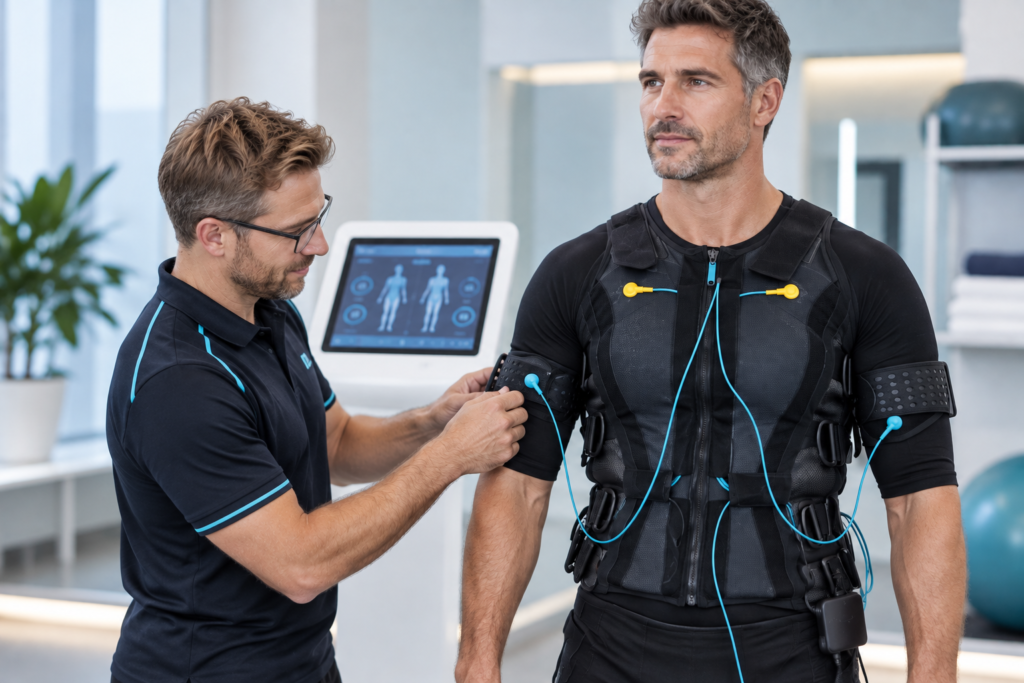
EMS works by delivering an electrical impulse that mimics the natural signal your nervous system normally sends to trigger a muscle contraction, bypassing the voluntary decision to move and activating the muscle directly. Research suggests this process engages both the muscle and nervous system somewhat differently than a voluntary contraction does, in ways that may be genuinely useful in specific settings. Notably, EMS appears to preferentially recruit fast-twitch muscle fibers, the fiber type most associated with power and strength. Recent research also points to EMS engaging corticomotor pathways, meaning the effect isn’t purely local to the muscle but also involves the central nervous system, similar to some of what happens during high-intensity voluntary exercise.
This is a genuinely different activation pattern than normal exercise, which is part of why EMS has found real clinical use in situations where voluntary muscle activation isn’t possible or isn’t enough on its own, described below.
Choosing intensity and session length
EMS intensity is typically described in milliamps, and the right setting depends heavily on what you’re using it for and where. Devices built for larger muscle groups, like the thighs or glutes, generally use higher intensities to produce a functional contraction, while facial EMS devices operate at much lower intensities suited to smaller, more delicate muscles. As with TENS, the general guidance is to start at the lowest intensity that produces a noticeable, comfortable contraction and increase gradually. Follow your specific device’s manufacturer guidance on session length and frequency, since these vary considerably between a clinical rehabilitation protocol, a sports-training device and a compact facial unit. If you’ve used a given muscle group with EMS recently and it’s still sore, that’s generally a sign to wait rather than continue at the same or higher intensity.
What the research says
Rehabilitation and medical use: the strongest evidence base. EMS has a long, well-established clinical track record for preventing muscle atrophy during immobilization, supporting recovery after ACL repair and knee replacement, addressing muscle weakness in knee osteoarthritis, and helping patients with limited capacity for voluntary exercise, including those with advanced cancer, COPD, or when they are on hemodialysis for kidney disease to maintain muscle function. This is the area of EMS use with the broadest, most established research support and it’s the origin of most of what we know about the technology’s genuine mechanism.
Sports performance: promising but methodologically uneven. A systematic review of EMS in soccer athletes examined 10 randomized controlled trials across 341 players, looking at strength, sprint and jump performance, recovery, and injury rehabilitation (Read more here: systematic review, EMS in soccer athletes). Six of the ten studies found significant performance improvements and four found accelerated recovery or reduced rehabilitation time, with no EMS-related adverse effects reported across any of the included trials. But the review was candid about real limitations. Most studies lacked rigorous blinding. Only two of the ten were rated low risk of bias, wide variation in EMS parameters across studies prevented a formal meta-analysis and no female athletes were included. We’d describe this evidence as a genuine, promising signal rather than a settled conclusion, similar to how we’ve characterized some of the more preliminary modalities elsewhere on this site.

Facial toning and skin-tightening devices: the thinnest evidence of EMS’s use cases. This is the use case most relevant to the compact EMS devices built into some beauty tools, and it’s also where we found the least independent research. A review of at-home facial rejuvenation devices found that EMS is typically evaluated as part of multi-modal devices that combine it with radiofrequency, LED, or microcurrent, rather than as a standalone technology with its own dedicated evidence base. Combination devices generally outperform any single technology alone in the studies that have compared them. EMS clearly does produce a visible, measurable muscle contraction in the face just as it does elsewhere in the body, but the specific claim that repeated facial EMS produces a lasting skin-tightening or anti-aging effect rests on a considerably thinner and less independent body of research than EMS’s rehabilitation and sports-performance uses.
One claim worth flagging directly: weight loss. In the United States, the FDA has specifically declined to approve EMS devices that market a weight-reduction claim, on the straightforward physiological grounds that meaningful calorie burn requires substantial muscle mass to be engaged simultaneously through movement, something a small EMS device applied to an isolated area doesn’t produce. Does it work though? You may need to experiment with the device yourself. Of course, we don’t have any alternative that is quite as effective as full-body exercise… so far.
Who should be cautious, and why
Pacemakers and implanted electronic medical devices. EMS should not be used by anyone with a cardiac pacemaker or similar implanted device, given the direct electrical stimulation involved.
Placement over vital areas. Avoid applying EMS electrodes over the carotid sinus nerves in the neck, across the chest in a way that could affect the heart, or near the scalp in a way that could affect the brain, beyond electrodes specifically designed and positioned for facial use by the device manufacturer.
Pregnancy. Check with your doctor before using EMS during pregnancy, particularly over the abdomen.
Certain existing conditions. Anyone with a bone fracture, a burn, an active skin lesion, lupus or a history of blood clots or deep vein thrombosis should check with their doctor before using EMS, since muscle contraction in these situations can carry added risk.
As always, check with your doctor if any of the above applies to you and follow your specific device’s manufacturer guidance for electrode placement and intensity.
Frequently asked questions
Is EMS the same as TENS? No, though the two are frequently confused and sometimes built into the same device. EMS targets motor nerves to directly contract muscle; TENS targets sensory nerves to reduce pain perception. See our companion article on TENS for that mechanism specifically.
Can EMS replace exercise? No. EMS can be a genuinely useful complement to exercise and a meaningful tool in specific rehabilitation settings where voluntary exercise isn’t possible, but it engages a different, more limited activation pattern than full voluntary movement. The FDA’s stance on weight-loss claims specifically reflects that distinction.
Does EMS actually tighten skin or is that just muscle contraction I’m feeling? What you’re feeling is a genuine muscle contraction and that part is well established. Whether repeated facial EMS produces a lasting skin-tightening effect independent of that contraction is a claim with considerably thinner, less independent research behind it than EMS’s rehabilitation and sports uses. Most of the supporting research evaluates EMS as part of a multi-modal device rather than on its own.
Is it normal for EMS to feel uncomfortable? A noticeable muscle contraction is expected and is how EMS works. However sharp pain, burning or skin irritation isn’t and suggests the intensity is too high or the electrode placement or skin contact needs adjusting.
Can EMS cause muscle soreness? Yes, EMS can produce delayed-onset muscle soreness similar to unfamiliar exercise, particularly at higher intensities. Research suggests using EMS immediately after intense exercise, rather than before, may actually make post-exercise soreness worse rather than aiding recovery. It creates its own sort of workout.
How is EMS different from the strength gains reported in older Soviet sports-science research? Those early reports came from a specific research and training context that wasn’t well understood or consistently replicated when shared with Western researchers in the 1970s. Later, better-controlled research has confirmed EMS produces real neuromuscular adaptations, but the very large gains reported in that early era haven’t held up as a general expectation, which is part of why we’ve described the current sports-performance evidence as promising rather than settled.
Where this fits alongside our other articles
EMS shares its electrical-stimulation foundation with TENS, though the two work through entirely different pathways, motor nerves for muscle contraction versus sensory nerves for pain relief. It’s worth understanding both if you’re evaluating a device that combines them. It’s also worth reading alongside our radiofrequency article if you’re specifically considering a multi-modal beauty device, since RF currently has the more independently established evidence base for skin-tightening claims specifically.
If you have questions about EMS or want to talk through how it might fit alongside the other approaches we cover, you can get in touch for a Zoom call, an office visit, or a group demonstration.