Grounding, also called earthing, is the practice of putting your body in direct physical contact with the earth’s surface: standing barefoot on grass, sand, or soil, or using an indoor mat or sheet wired to a grounded outlet or a rod in the earth outside. It’s one of the simplest interventions in the wellness space and also one of the most debated. There’s a real, if still developing, body of research behind it. Let’s look at the details.
What is grounding?
The idea rests on a straightforward premise: the earth’s surface carries a mild negative electrical charge, maintained by a constant exchange between the planet, the atmosphere, and lightning activity worldwide. Human skin conducts electricity well. When bare skin touches the ground directly, the theory goes, the body’s electrical potential equalizes with the earth’s, and free electrons move from the ground into the body.

For most of human history, this contact was constant. People walked barefoot, slept on the ground, and wore leather-soled shoes that conducted electricity. Rubber and synthetic soles, which became standard through the twentieth century, along with elevated homes, insulated flooring, and life spent mostly indoors, changed that. Modern life largely insulates us from the ground we once touched every day. Grounding advocates argue that this shift is worth paying attention to, even if the science is still catching up to the claim.
A brief history
The modern grounding movement traces back to one man: Clint Ober, a former cable television executive. After retiring in the 1980s, Ober became curious about the parallels between grounding electrical equipment, which he’d spent his career doing and the idea of grounding the human body. In the mid-1990s, following a personal health setback, he started experimenting on himself, sleeping on a grounded conductive sheet and tracking how he felt.
Ober spent the years that followed funding and organizing research into the idea, working with physicians and researchers to test grounding under controlled conditions. That collaboration produced the first wave of published studies on grounding in the 2000s and 2010s, and the research base has grown steadily since, though it remains small compared to more established modalities like PEMF.
Electrons, free radicals and the body
The proposed mechanism behind grounding centers on free electrons and their role in neutralizing free radicals which are unstable molecules with an unpaired electron that steal electrons from healthy cells and tissue. This process is called oxidative stress. Oxidative stress is implicated in inflammation and a long list of chronic conditions, which is part of why antioxidants get so much attention in general health advice.
The theory is that the earth functions as a virtually unlimited reservoir of free electrons. That skin contact with the earth allows those electrons to enter the body and travel through it via connective tissue, a network researchers sometimes call the “living matrix.” Once inside the body, the electrons are proposed to act as antioxidants themselves, donating electrons to neutralize free radicals directly at the site of inflammation, rather than requiring the free radical to travel to an antioxidant molecule first (Read more here: Chevalier, Sinatra, Oschman, Sokal, and Sokal, 2012, Journal of Environmental and Public Health).
This is a genuinely interesting hypothesis and it fits with what’s known about bioelectricity more broadly, the same field of cellular electrical signaling we cover in our PEMF pillar page. It hasn’t been proven to the standard that would make it settled science. The proposed pathway is plausible on paper, but the evidence that it plays out this way in the human body, at meaningful scale, is still being built.
The Schumann resonance
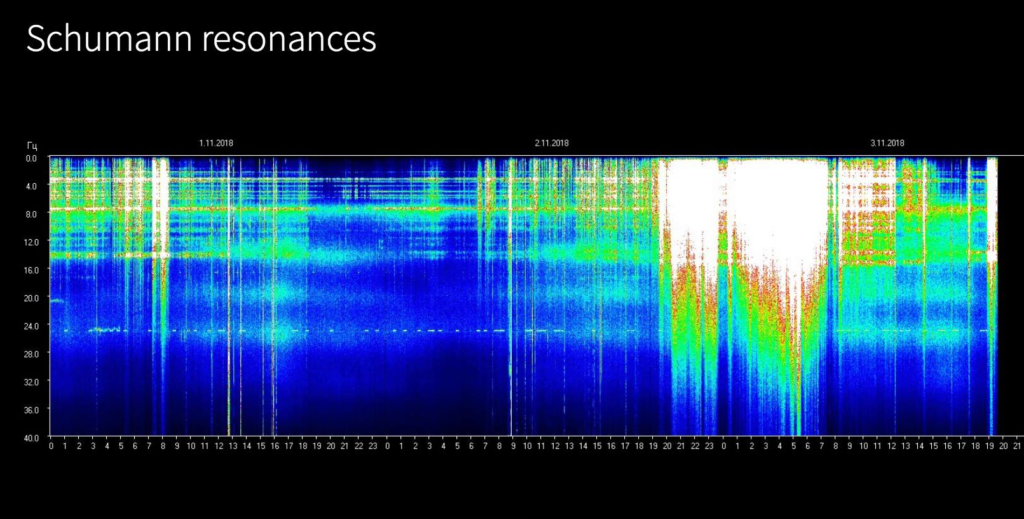
The earth itself has a natural electromagnetic pulse. The space between the earth’s surface and the ionosphere forms a cavity that resonates at extremely low frequencies, driven largely by the roughly 2,000 lightning storms happening around the globe at any given moment. German physicist Winfried Otto Schumann predicted this resonance mathematically in 1952. It was measured and confirmed a few years later. The fundamental frequency sits at approximately 7.83 Hz, with several weaker harmonics above it. (The chart above shows how, occasionally, the frequency can spike up over 40 Hz.)
Grounding advocates sometimes point to the Schumann resonance as a companion piece to the electron-transfer mechanism described above, not just a source of free electrons, but a constant, low-frequency electromagnetic signal the earth has been generating throughout human history. They see it as one that overlaps with the frequency range of human alpha brainwave activity. Direct contact with the ground is proposed as one way the body stays exposed to it, alongside the electron transfer covered earlier. This part of the picture is more speculative than the studies below, but it’s a genuinely interesting piece of the broader story of the earth’s own electrical activity and part of why grounding resonates with people already interested in bioelectricity.
If you’re curious what the Schumann resonance looks like in real time, this monitoring station publishes live readings updated continuously.
What the research says
The published research on grounding is smaller in volume than PEMF‘s, but it covers a fairly wide range of outcomes.

Blood viscosity. A 2013 study measured blood samples before and after two hours of grounding and found a measurable reduction in blood viscosity and clumping, along with an increase in zeta potential, a measure related to how well red blood cells repel each other and flow freely. Reduced blood viscosity is relevant to cardiovascular health generally (Read more here: Chevalier, Sinatra, Oschman, and Delany, 2013, Journal of Alternative and Complementary Medicine).
Inflammation, immune response, and wound healing. A widely cited review pulled together the existing grounding studies on inflammation and immune markers, reporting associations between grounding and reduced inflammatory response and improved wound healing across the available small studies. The authors were also candid that grounding as a treatment for chronic inflammatory conditions “deserves serious consideration” but needs considerably more research before that conclusion can be drawn with confidence (Read more here: Oschman, Chevalier, and Brown, 2015, Journal of Inflammation Research).
Athletic recovery. A 2019 triple-blinded randomized controlled trial had participants sleep grounded or sham-grounded for ten days following an intensive downhill treadmill workout designed to induce muscle damage. The grounded group showed a less pronounced drop in jump and strength performance and smaller increases in creatine kinase, a blood marker of muscle damage, along with more stable red blood cell counts and lower levels of several inflammation markers. Neither group had fully recovered by day ten, and the study involved only 22 participants (Read more here: Müller, Ryan, Zimmermann, and Ratzinger, 2019, Frontiers in Physiology).
Broader review. A 2020 review in the journal EXPLORE summarized roughly twenty studies on grounding, covering sleep quality, cortisol patterns, autonomic nervous system activity, mood, and pain, and concluded the accumulated evidence supports grounding as worth including in clinical practice as a low-cost, low-risk intervention (Read more here: Menigoz, Latz, Ely, Kamalden, Comerford, and Vitetta, 2020, EXPLORE).
Taken as a whole, this is a body of research that’s consistently pointed in a positive direction across several small studies, on outcomes ranging from blood flow to muscle recovery to inflammation markers. What it hasn’t yet produced is the kind of large, independently replicated trial that would settle the question conclusively.
The PEMF connection
We’ve written elsewhere about PEMF therapy and its own separate research base, and we think it’s worth drawing the connection here directly, because the two modalities share a conceptual foundation even though they work through different physical mechanisms.
Grounding proposes a passive transfer of electrons through direct skin contact with the earth, dependent on where you are and what you’re standing or lying on. PEMF generates a pulsing magnetic field that interacts with the body’s own electrical activity on demand, indoors, at a chosen intensity, without needing bare feet on the ground. Practitioners who work with both often describe PEMF as a way to access a related kind of electrical support more consistently than grounding conditions typically allow. We find that framing useful as a way to think about why the two show up together so often in this space, though we’d stop short of calling them interchangeable. They’re related ideas investigated by mostly separate bodies of research and we’ve tried to represent each one on its own terms rather than blur them together.
Who should be cautious, and why
Grounding is about as low-risk as wellness practices get, but a few situations are worth knowing about.
Blood thinning medication. Because grounding has been associated with measurable changes in blood viscosity and clotting behavior in the research above, anyone taking anticoagulant or antiplatelet medication should talk to their doctor before adopting a regular grounding practice, particularly a daily one.
Electrical safety with indoor grounding devices. Grounding mats, sheets and bands plug into a wall outlet’s ground port or connect to a rod placed in the earth outside. That means proper installation matters. A grounding device connected to an ungrounded outlet, an outlet with reversed wiring, or a home with older electrical infrastructure might not work as intended and, in rare cases, could create a safety issue. If you’re using an indoor grounding product, it’s worth having your outlet’s grounding verified. This is something an electrician can check quickly with an inexpensive tester.
Outdoor grounding in extreme weather. Standing on wet ground during a lightning storm carries an obvious and unrelated electrical risk that has nothing to do with grounding’s proposed benefits. Use common sense about weather conditions when grounding outdoors.
We wouldn’t say avoid grounding altogether. They’re just reasons to be sensible about how you do it.
Frequently asked questions
Do I need a special device to try grounding? No. The simplest version costs nothing: bare feet on grass, sand, or dirt that’s in direct contact with the earth (not on top of asphalt, which typically isn’t conductive in the same way). Indoor grounding mats, sheets and bands exist for people who want to ground while sleeping, working or during colder months when going barefoot outside isn’t practical.
How long do I need to be grounded before it does anything? The research doesn’t point to one specific answer. Some studies measured effects after as little as forty minutes to two hours of contact, others tracked outcomes over ten days of grounded sleep.
Is grounding the same as walking barefoot for exercise? Related but not identical. Barefoot walking has its own separate research around foot mechanics and strength. Grounding is specifically about the electrical contact with the earth, which barefoot walking outdoors happens to provide, but the proposed mechanism is different from the biomechanical benefits of barefoot movement.
Can indoor grounding mats really substitute for bare feet on the ground? That’s the premise behind them and the properly installed devices are designed to replicate the same electrical contact. Installation and a genuinely grounded outlet matter for this to work as intended, which is worth double-checking if you’re relying on an indoor device.
Is there any harm in trying grounding even if the research is still developing? For most healthy people, no. It’s free or low-cost, non-invasive and the cautions above cover the realistic situations where it’s worth checking with a doctor or an electrician first.
Where this fits in the bigger picture
We’ve been candid throughout this page that grounding’s evidence base, while real and growing, is thinner than some of the other modalities we cover. If you want to explore the technology that has a larger and more established body of research behind it, our PEMF page is the natural next read. If you have questions about any of this, or want to talk through how grounding and PEMF relate for your own situation, you can get in touch for a Zoom call, an office visit, or a group demonstration.