Some waves are all around us, even though we can’t see them. Radio waves carry music to your car. Microwaves heat your leftovers. Infrared waves let you feel the warmth of the sun on your skin.
Terahertz waves sit right in the middle of that family. For a long time, scientists found them almost impossible to make or measure. Today, researchers are discovering that these waves can work with some of the body’s most important molecules, especially the ones that control blood flow.
This guide explains what terahertz waves are, who discovered them and what the research says they can do for you.
What are terahertz waves?
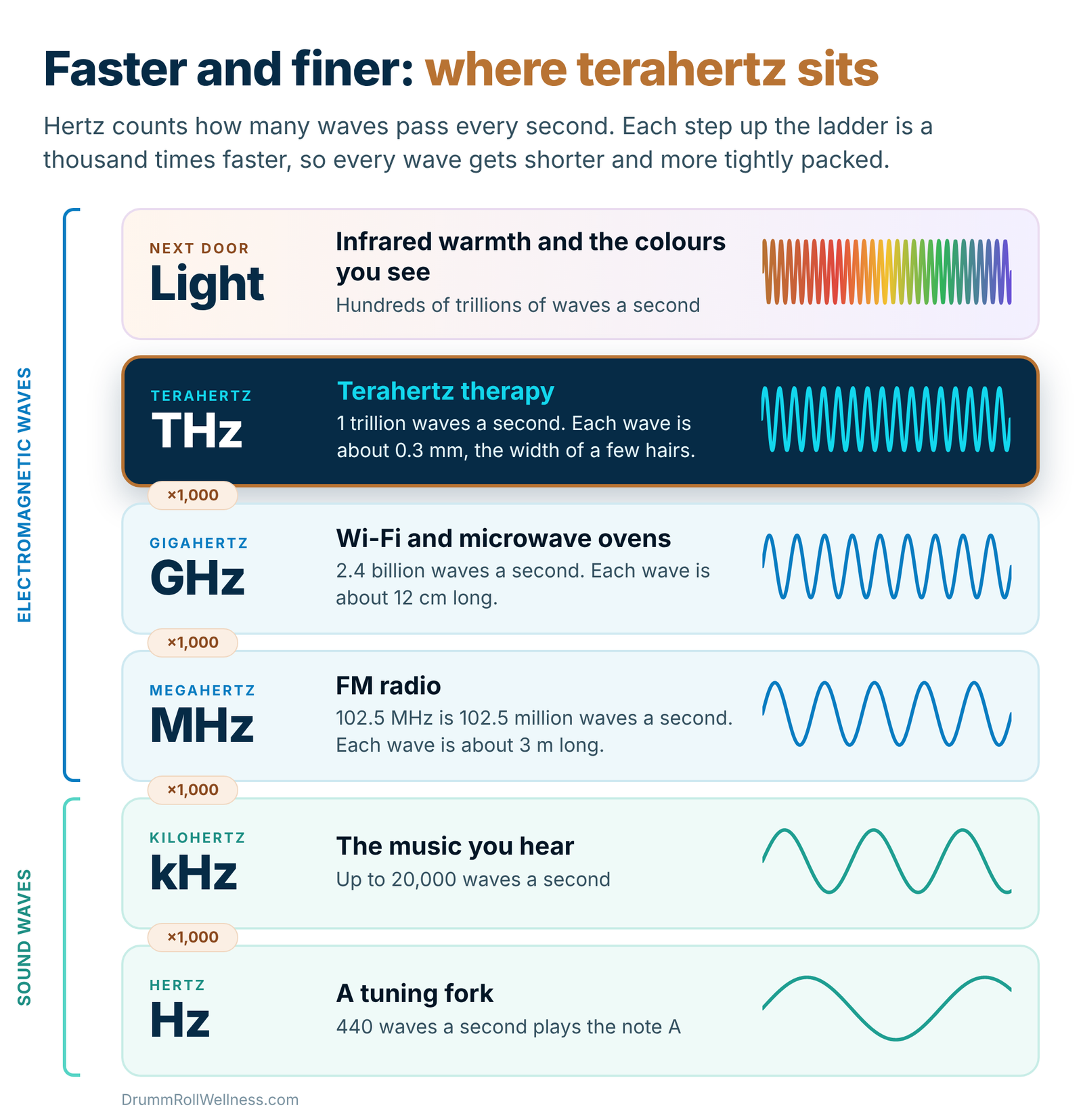
Have you ever struck a tuning fork? It vibrates back and forth, very fast. Scientists measure how fast in hertz. One hertz means one wave every second. A tuning fork playing the note A makes 440 waves a second.
Now climb the ladder. Each step up is a thousand times faster:
- Kilohertz (thousands of waves a second): the music you hear
- Megahertz (millions a second): FM radio
- Gigahertz (billions a second): Wi-Fi and microwave ovens
- Terahertz (trillions a second): terahertz therapy
The faster the waves, the shorter and more tightly packed each one becomes. An FM radio wave is about 3 metres long. A terahertz wave is about 0.3 mm, roughly the width of a few hairs.
There’s one difference between the steps. Tuning forks and music make sound waves, which are vibrations in the air. Radio, Wi-Fi and terahertz are electromagnetic waves, a kind of invisible energy that can even travel through space. Terahertz sits just below infrared, the warmth you feel from the sun.
Are they safe?
Terahertz waves are non-ionising. This means they don’t carry enough energy to damage your cells or DNA, the way X-rays can. They belong in the same safe group as radio waves, microwaves and infrared light.
You may have already met waves like these without knowing it. Some airport body scanners use waves close to this range, because they pass through clothing and bounce back off skin.
Where terahertz therapy came from
1890s: Searching for the missing waves
By the late 1800s, scientists knew about radio waves and infrared light. But nobody could find the waves in between. German physicist Heinrich Rubens became the first scientist to explore this mystery zone. He worked with American physicist Ernest Nichols, and together they pushed infrared research further than anyone before. (Read more here: Beyond the infrared)
Scientists still call this zone the terahertz gap, because it was so hard to reach.
1923 to 1924: The gap is closed
In 1923, Ernest Nichols and J.D. Tear finally detected waves in the terahertz range in the United States. (Read more here: High Frequency Electronics)
At the same time, two Russian women made history. At Moscow State University, physicist Alexandra Glagoleva-Arkadieva invented a “mass radiator”. It produced a whole spread of waves stretching from radio all the way into the terahertz zone. She published her results in the journal Nature in 1924. Another Russian physicist, Maria Levitskaya, produced terahertz waves that same year. (Read more here: Physics-Uspekhi)
1960s to 1980s: Soviet scientists discover the health effects
The next big step also came from Russia. Engineer Nikolay Devyatkov spent his career building machines that made very fast, very short waves. In 1973, he presented research showing these waves could affect living things. (Read more here: Physics-Uspekhi)
Devyatkov and his team developed the science behind a new treatment they called EHF therapy (extremely high frequency therapy). It used gentle, low-power waves just below the terahertz range. In the mid-1980s, his team built the first EHF therapy machine for patients. (Read more here: Wikipedia)
Soviet doctors used EHF therapy for stomach ulcers, heart and blood pressure problems, and conditions affecting the nerves. (Read more here: EMF-Portal) It became a mainstream treatment. By 1995, more than 1,000 clinics across the former Soviet Union had used it with over three million patients. (Read more here: Temple University)
During the Cold War, the US kept a close eye on Soviet science. In 1993, a research team working under a US government contract gathered decades of Soviet studies on how these waves affect the body. The report was released to the public in 2000. (Read more here: CIA Reading Room)
Even so, EHF therapy never caught on in the West. Most of the Soviet research was published in Russian, and many studies were hard for Western scientists to check. Western doctors wanted more proof before they would use it. (Read more here: Temple University)
1990s: Terahertz technology takes off
In the 1990s, new lasers and electronics finally made terahertz waves easy to create and measure. Scientists began using them to take pictures through materials and to identify chemicals. Medical researchers, mostly in Russia and later in China, began exploring terahertz frequencies for health too.
2000s: Tuning in to nitric oxide
At Saratov State Medical University in Russia, Professor Vyacheslav Kirichuk and his team had a clever idea. Every molecule vibrates at its own special set of frequencies, a bit like a musical note. What if a device sent out waves at exactly the same “note” as a helpful molecule in the body?
They chose nitric oxide, a molecule your body uses to relax and widen blood vessels. Working with engineers, they built a device called Orbita. It sends out waves matched to the natural frequencies of nitric oxide and oxygen. (Read more here: Russian Open Medical Journal)
In 2013, a Russian medical journal published a whole special issue about terahertz waves in medicine. (Read more here: Russian Open Medical Journal)
How terahertz works in your body
Molecules that “hear” the right note
Think of a singer who hits the perfect note and makes a wine glass ring. The glass picks up that one note because it matches the glass’s own natural frequency. Scientists call this resonance.
Many of the body’s important molecules, including water and nitric oxide, naturally vibrate at terahertz frequencies. Researchers believe terahertz waves can “tune in” to these molecules and give them a gentle boost.
Better blood flow
Nitric oxide is one of your body’s key helpers for circulation. When it does its job, your blood vessels relax and open up. More blood can then flow to your muscles, joints and skin, bringing oxygen and nutrients with it.
Researchers think terahertz waves matched to nitric oxide may help it do this job better. That could explain why studies keep finding improved blood flow in the areas being treated.
Gentle warmth
Terahertz waves carry very little energy. Some of their effects may also come from mild warming of the skin. Scientists are still working out how much of the benefit comes from resonance and how much comes from warmth.
The benefits of terahertz: what the research shows
Terahertz therapy is younger than PEMF, and most studies so far are small. Even so, researchers keep reporting encouraging results. Here’s what they’ve found.
1. Improved circulation
Improved blood flow is the most common finding across terahertz research. Better blood flow means your blood can carry more oxygen and nutrients to cells all over your body, and carry waste away. In lab studies, waves tuned to nitric oxide helped restore healthy blood flow in the tiny blood vessels of animals under stress. (Read more here: Saratov Journal of Medical Scientific Research)
2. Easing knee pain
Osteoarthritis is wear and tear inside a joint. In a trial of 65 people with knee osteoarthritis, one group had standard treatment of medication and exercise. The other group had the same treatment plus terahertz therapy. The terahertz group had less pain, better movement and better blood flow around the knee. People also found the treatment comfortable. (Read more here: terahertz knee osteoarthritis trial)
3. Supporting heart health
Angina is chest pain that happens when the heart doesn’t get enough blood. In a study of 56 people with angina, doctors added terahertz therapy to their usual heart medication. Both the middle-aged and older patients had fewer angina attacks. (Read more here: terahertz angina study)
4. Calming stress and inflammation
In lab studies, terahertz waves at nitric oxide frequencies calmed the body’s stress response and helped protect tissues from damage. A 2026 review of terahertz research also lists reduced inflammation as one of the ways terahertz may help. (Read more here: Frontiers in Photonics)
5. A growing list of uses
That same 2026 review looked at terahertz studies going back to 1989. Researchers reported good results for knee osteoarthritis, angina, male fertility and heavy periods. The reviewers also said that better devices and bigger studies will help terahertz therapy reach its full potential. (Read more here: Frontiers in Photonics)
The big picture
The clearest benefit of terahertz is better circulation, and it shows up again and again. Pain relief for knees and support for heart health are the next most promising areas.
Terahertz waves only reach the outer layer of your skin. That layer is full of tiny blood vessels and nerve endings, so the benefits travel further. Your blood flow and your nervous system carry them deeper into the body.
That’s one reason many people use terahertz through the soles of their feet. Your soles are packed with nerve endings and small blood vessels. They’re also where reflexology practitioners work with points they link to other parts of the body.
Most of this research comes from Russia and China, and the studies are smaller than those for PEMF. It’s an exciting, fast-growing field. (See how we judge the evidence: How we review wellness devices)
Who should check with a doctor first
Terahertz waves are low-energy and non-ionising, so they have a good safety record. Still, talk to your doctor before using terahertz therapy if any of these apply to you:
- You have a bleeding or clotting disorder, or take blood thinners. Terahertz may change blood flow. That’s usually a good thing, but it’s worth checking if your condition makes blood flow changes risky.
- You’re pregnant. Nobody has properly studied terahertz therapy during pregnancy yet. Without research, the safe choice is to wait.
- You have an ongoing health condition. Let your doctor know, simply as good practice.
As with any device that gives off energy, avoid pointing it directly at your eyes. Always follow your device’s manual.
Common questions
Is terahertz dangerous, like an X-ray?
No. X-rays carry enough energy to damage DNA. Terahertz waves don’t. They belong to the same gentle group as radio waves and infrared light.
How deep do terahertz waves go?
Not very deep. Terahertz waves are soaked up by water, and your skin is mostly water. So they work in the top fraction of a millimetre of your skin.
That’s where some of your smallest blood vessels and many of your nerve endings sit. Researchers believe the effects start there, then travel further through your blood flow and nerves. In devices that combine terahertz with PEMF, the PEMF is the part that reaches deep into muscle and bone.
Will I feel anything?
Most people feel a gentle warmth, or nothing at all. It shouldn’t hurt.
How long is a session?
In the research, sessions ranged from a few minutes to longer courses over several weeks. Follow your device’s manual for how long and how often to use it.
How is terahertz different from radiofrequency and far-infrared?
All three are invisible waves, but they sit on different steps of the ladder. Radiofrequency warms tissue deeply. Far-infrared gives a soft, soothing warmth. Terahertz sits between them and is thought to work mainly by tuning in to molecules like nitric oxide. Read more in our radiofrequency and far-infrared articles.
Is terahertz the same as “quantum” or “scalar” energy?
No. Scientists can measure terahertz waves precisely, and the physics behind them is well understood. Read our article on scalar and quantum energy to learn how those claims compare.
Why does so much of the research come from Russia?
Russian scientists have studied how these waves affect the body for more than 50 years, ever since Devyatkov’s early work. Much of their research was published in Russian, so it’s less well known in the West. China is now doing more research too.
Want to try terahertz for yourself?
The best way to understand terahertz therapy is to experience it. If you’re in the Sydney area, get in touch to book an appointment, a visit to your workplace or a demo with friends.
Live further away? Book a Zoom call instead. We’ll talk you through how terahertz works and help you decide whether it’s right for you.